Case No. #1494
The Underwater Light Source in Lake Chūzenji
Summary
Between October and November 2022, six reports reached the Bureau from tourists and local residents describing a greenish-white luminous area visible from beneath the surface of Lake Chūzenji in Nikkō, Tochigi. The light appeared in the deeper central zone rather than shallow margins. On-site investigation ruled out reflection from external light sources. No bioluminescent fish or crustacean species are confirmed residents of the lake. A limnologist cited autumn thermal overturn as a theoretical partial explanation but found it insufficient to account for the reported scale.
Details
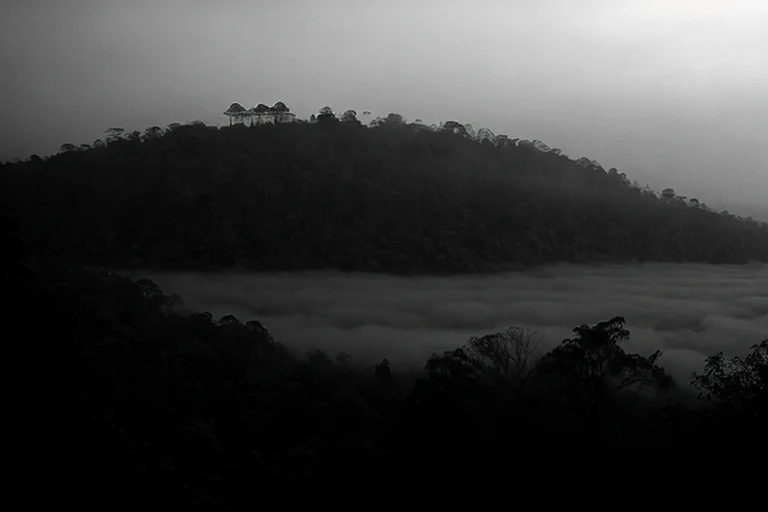
Lake Chūzenji is a crater lake on the slopes of Mount Nantai in Nikkō, Tochigi, with a maximum depth of 163 meters. A high-altitude tourist destination, the lake's shores are nearly empty on winter nights.
On the night of October 21, 2022, a couple staying at a lakeside accommodation observed from their viewing deck a circular area of greenish-white light apparently emanating from beneath the lake surface, offshore from the shore. The lit area was estimated at 10–20 meters in diameter. The light pulsed slightly with wave movement and persisted for approximately thirty minutes before fading. Photographs captured only a faint luminous region.
Five further reports were filed during November, all during the late-night to pre-dawn window, all concentrated in the same zone slightly east of the lake's center. One witness — a fisherman who reached the bank at 4:00 a.m. — described the water as "glowing blue-white in the distance." He launched a boat to approach the area; the light faded before he reached it.
A night investigation was conducted to check whether Nikkō streetlights, highway lighting, or facility illumination could account for the phenomenon through surface reflection. The geographical relationship between the light sources and the relevant section of the lake showed that terrain obstructed any line of sight. External reflection was ruled out. No bioluminescent species are known to inhabit the lake.
A limnologist noted that autumn lake overturn, when cold bottom water rises to the surface, can in theory involve minor bioluminescent activity during organic decomposition. However, this mechanism produces only faint, diffuse glow and is not expected to generate a coherent, visually distinct illuminated area of 10–20 meters in diameter.
Timeline
- Oct 21, 2022 — nightLodging guests observe a 10–20 m circular luminous area below the lake surface from their deck. Persists ~30 min.
- November 2022Five further reports, all late night/pre-dawn, in the same central-east zone.
- November 2022 (night survey)On-site investigation eliminates external light sources; terrain blocks all candidate light paths.
- Winter 2022Survey for bioluminescent species in the lake; none confirmed.
- Spring 2023Limnologist considers autumn overturn hypothesis; finds it insufficient to explain reported scale.
- PresentObservation plan prepared for following autumn to check recurrence.
Witness Testimony
Lodging guest (male, 50s)"There was light in the lake offshore. Not a streetlight reflection — it was coming from inside the water. My wife saw it too. It lasted about thirty minutes and then suddenly went out. I had no explanation."
Fisherman (male, 30s)"I reached the bank at 4 a.m. and the water offshore was glowing blue-white. Thirty years of fishing and I've never seen anything like it. I launched a boat. The light faded before I got there."
Limnologist (male, 50s)"Autumn overturn can theoretically involve minor bioluminescent activity. But a visually distinct 10–20 meter lit area — that scale doesn't fit standard organic decomposition. Something else may be involved."
Kyu's Analysis
No external light source. No bioluminescent species. In autumn, the lake bottom lights up. Lake Chūzenji carries its own illumination.