
Case No. #1680
South Aral Sea Shore: 'Inverted Distant Vista and Vanishing Ship Shadows' Periodic Spatial Anomaly Incident
Summary
In the early hours of October 12, 2017, near Muynak, a former fishing port in the southern Aral Sea, Uzbekistan, a phenomenon was observed where non-existent structures appeared inverted on the horizon. This spatial anomaly occurs periodically under specific atmospheric conditions, manifesting as distant shipwrecks floating upside down in the sky or glimpses of entirely different historical landscapes superimposed on the present. Attempts by the agency's investigation team to approach the phenomenon consistently resulted in its disappearance, leaving behind only unexplained data anomalies on their monitoring equipment. Locally, it is known as 'The Mirage of the Empty Sea' and has been passed down through generations, defying scientific explanation to this day.
Details
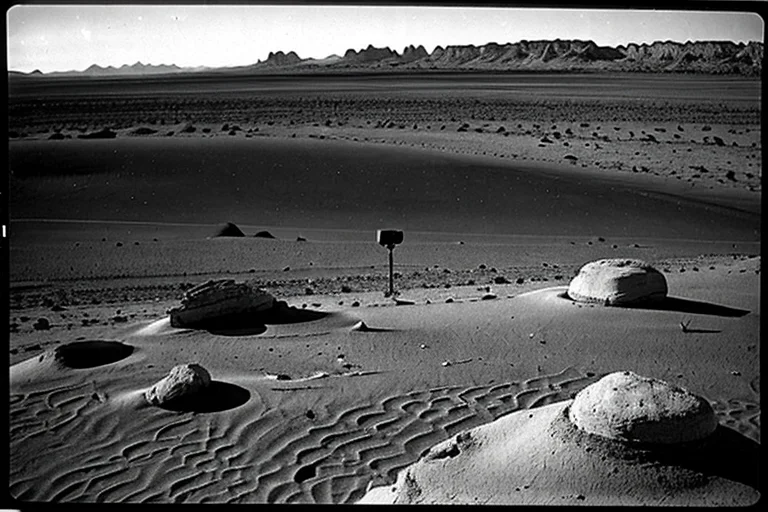
At 03:17 on October 12, 2017, an agency observation team stationed near Muynak encountered a situation where structures that should not exist became visible approximately 15 km away on the dried lakebed. The hull of a massive ship appeared inverted in the sky, with a shimmering blue light, resembling water, beneath it. This scene persisted for about 20 minutes before slowly dissolving into the horizon.
Similar phenomena have been reported multiple times in the past. In the 1990s, records exist of former fishermen testifying to seeing apparitions of 'the good old Aral Sea' at dawn. These were said to be visions of the rich sea before its desiccation and fishing fleets that no longer exist. In 2005, a geological survey team discovered an image of an inverted mountain range, inconsistent with known topography, in a panoramic photograph taken in a remote area. These instances showed unnatural inversions and structures that could not be explained by mere mirages.
Initial investigations by the agency treated the incidents as specialized mirage phenomena caused by strong temperature inversion layers. However, detailed meteorological data analysis found no specific weather patterns coinciding with the events. Furthermore, the frequency of occurrences and the diversity of observed landscapes led to the conclusion that these phenomena exceeded the scope of atmospheric optical effects. Particularly, historical records describing 'reflections as if on water' and 'the appearance of entirely different landscapes' are difficult to explain solely by refractive index anomalies.
On September 23, 2020, at 04:05, a remote surveillance camera successfully captured the phenomenon. However, the recorded footage only incompletely reflected the spatial distortion and color changes observed visually. Simultaneously, active radar showed abnormal reflection patterns, and GPS coordinates recorded errors of up to 200m for several minutes. Acoustic sensors detected a very low-frequency, constant pulsation, deemed unnatural, but its waveform was unstable and contained intermittent gaps.
Each time the investigation team attempted to approach the incident location, the phenomenon rapidly dissipated. In one instance, a drone tracking the phenomenon suddenly lost control, only to recover just before crashing. The recovered drone's records showed severe video and audio noise in the few seconds before the near-crash, with the surrounding space appearing to ripple as if underwater. The characteristics of this noise do not align with electromagnetic field anomalies.
Currently, this incident is classified as a 'Periodic Local Spatial Anomaly Incident,' and surveillance has been intensified. There is a high probability that unknown factors, particularly those beyond meteorological conditions, are strongly involved in the phenomenon's occurrence. A connection to the rapid environmental changes in the Aral Sea cannot be ruled out, but concrete evidence remains elusive. The agency is investigating the possibility that this spatial distortion projects landscapes from the past, present, and future at random.
Timeline
- 1990s (Undated)Former fishermen witnessed apparitions of 'the good old Aral Sea'.
- August 15, 2005Geological survey team's panoramic photo shows an unnatural inverted mountain range.
- October 12, 2017, 03:17Agency observation team visually confirms an inverted ship shadow and water surface near Muynak, lasting approx. 20 minutes.
- September 23, 2020, 04:05Remote surveillance camera records the phenomenon. Radar anomalies, GPS errors, and low-frequency pulsations detected.
- Around 05:00, April 7, 2021A drone tracking the phenomenon loses control. Footage records spatial ripples and noise.
Witness Testimony
Former Fisherman N.S.It was before dawn. On the horizon, I clearly saw Muynak as it was when the sea was still abundant. Ships came and went, and I could even hear the sound of waves. But it was a scene from my memory.
Agency Investigator K.T.As we attempt to approach the phenomenon, it always recedes and eventually dissipates. It's as if its physicality is lost the moment we acknowledge its existence. The anomalies in our monitoring equipment suggest that our perception interferes with the phenomenon itself.
Kyu's Analysis
Unexplained. The drastic environmental changes in the Aral Sea may be causing distortions in the spatial structure itself. Continued observation of the phenomenon is imperative.