Case No. #1607
Uzbekistan, Aral Sea: "Past Illusions Reflected on the Dried Lakebed" Spatial and Temporal Perception Anomaly Incident
Summary
On August 14, 2018, near Muynak, Karakalpakstan, Republic of Uzbekistan, a phenomenon of visually appearing past landscapes was reported on the dried seabed of the Aral Sea. A geologist from an international research team perceived the former water surface, the sound of waves, and a sense of humid air simultaneously at a specific point. This phenomenon involved sensory effects inexplicable by temporary hallucinations or mirages, and similar testimonies were collected from multiple local residents. The authorities have recorded this as a spatial and temporal perception anomaly incident and continue meticulous investigation into its occurrence conditions and reproducibility.
Details
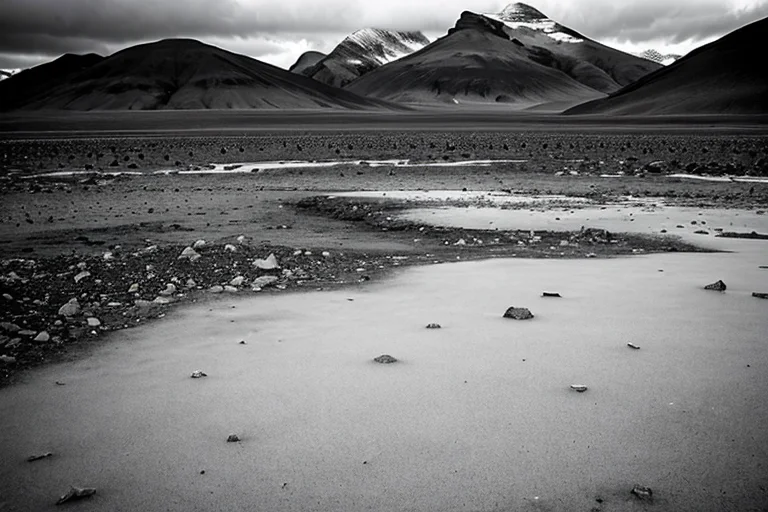
On August 14, 2018, at 3:17 PM, an international research team conducting geological surveys reported an anomalous sensory perception phenomenon on the dried seabed of the Aral Sea, approximately 50 kilometers southwest of the former port city of Muynak in Karakalpakstan, Uzbekistan. Dr. Elizabeth Vargas, the team leader, reported clearly perceiving the reflection of a water surface that should not exist on the ground, the sound of distant waves, and humid air. Other team members initially dismissed it as a visual illusion caused by a strong sandstorm, but Dr. Vargas described in detail even the shadows of old fishing boats reflected on the visible water surface.
Following this initial report, the authorities immediately launched a preliminary investigation. Multiple testimonies were gathered from former residents of the surrounding area, especially elderly individuals who once worked in fishing, stating they "saw the old sea" or "heard the sound of waves" at specific locations on the dried lakebed. These testimonies were not mere nostalgic expressions but were recounted as experiences perceived through all five senses, with clear tendencies regarding timing and weather conditions. In particular, the phenomenon was reported to occur more frequently in the evening on humid, calm days.
A team of specialists dispatched by the authorities conducted precise physical and electromagnetic measurements at the incident site. Results showed unusual noise in specific frequency bands that would typically be impossible, and high-precision gravimeters recorded data suggesting localized gravitational fluctuations. However, optical and acoustic sensors deployed during the phenomenon detected no abnormal light or sound whatsoever. This suggests the perceived phenomenon may not be due to external physical stimuli.
During the investigation, some observation team members reported severe nausea and dizziness when the phenomenon occurred, remaining disoriented for several hours. They testified, "time warped," and "for a moment, I felt like I was in a different place." This indicates the unique nature of the incident, where perception itself transforms, rather than merely a visual illusion. The authorities do not rule out the possibility that this phenomenon is related to some energy field directly affecting cognitive functions of the brain.
Furthermore, a review of historical documents revealed a striking consistency between maps of the Muynak area from before the 1970s, when the Aral Sea was still abundant, and the perceived content at the current incident location. This supports the hypothesis that the phenomenon is not merely an accidental illusion but that specific "past information" is somehow fixed in space and manifests under certain conditions. However, its mechanism remains entirely inexplicable by current science.
The authorities consider this incident extremely important. Taking into account the possibility that environmental changes in the Aral Sea may have triggered an unknown physical phenomenon, we plan to establish a large-scale spatiotemporal observation network. The perceived past phenomena observed at specific points are hypothesized to be memories etched into the very structure of space, and further in-depth investigations continue.
Timeline
- August 14, 2018, 15:17Leader of international geological survey team reports past landscape and perception anomaly on Aral Sea lakebed.
- August 15, 2018Collection of similar testimonies from local residents begins.
- August 20, 2018Authorities dispatch a specialist team, initiating physical and electromagnetic measurements.
- August 23, 2018Observation team members experience perceptual anomalies, some losing sense of direction.
- September 5, 2018Historical data corroborates consistency between past landscapes and observed phenomena.
- 2019 onwardsPlanning for a large-scale spatiotemporal observation network initiated, investigations ongoing.
Witness Testimony
Witness A (Dr. Elizabeth Vargas, Geologist)The horizon should have been desert. But I saw a blue water surface there. I heard the sound of waves crashing, and even smelled the salty air. It wasn't a hallucination. I was truly within that scene.
Witness B (Anonymous, Former Fisherman)I've seen it many times. In that spot, I see the old boats floating. I hear the sound of waves, even children's voices. It's the dead Aral Sea trying to remember its old self.
Kyu's Analysis
This incident suggests that specific spatial locations may retain past information and affect senses under certain conditions. It is inexplicable by our known laws of physics. Thorough continuous investigation is imperative.