Case No. #1471
The Burned Shadows of an Okinawa Ruin
Summary
In June 2018, a freelance writer investigating an abandoned hotel in southern Okinawa discovered multiple human-shaped dark imprints burned into the concrete walls of a third-floor corridor. The imprints did not align with any current light source. The facility is believed by local oral tradition to have served as a field hospital during the Battle of Okinawa in 1945. Analysis of wall samples revealed an uneven distribution of organic carbon inconsistent with standard weathering. Multiple subsequent visitors confirmed the shadows' presence.
Details
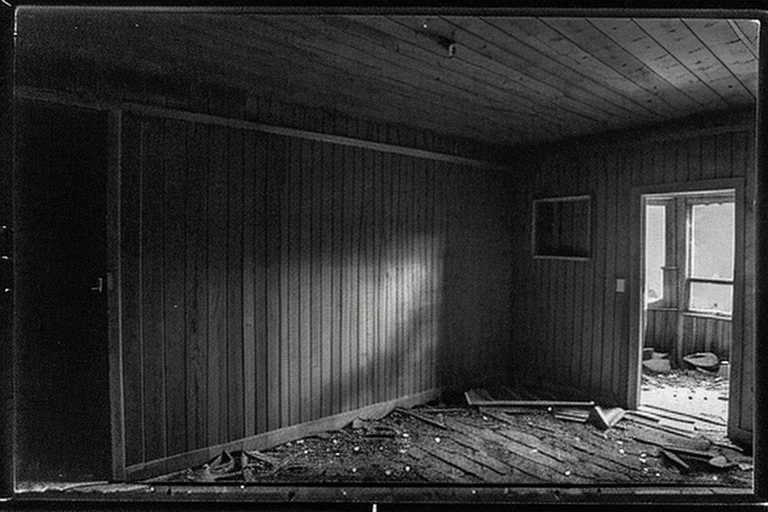
On June 10, 2018, a writer specializing in abandoned structures entered the corridors of a derelict hotel in southern Okinawa's main island and found five human silhouettes imprinted on the eastern wall of the third-floor hallway and two on the western wall. The imprints appeared to be embedded directly in the concrete surface — not painted, not shadowed by a current light source. The angle of available sunlight entering through broken windows did not align with the direction the silhouettes faced. The writer photographed them and contacted the Bureau that same day.
Bureau investigators reached the site the following week and extracted wall surface samples. Analysis found an irregular distribution of organic carbon across the imprinted areas, a pattern inconsistent with standard weathering or UV degradation. A specialist in atomic bomb-related thermal shadow phenomena — referencing the famous "shadow on the stone steps" preserved at the Hiroshima Peace Memorial — was consulted. The specialist concluded that generating such imprints through heat would require thousands of degrees of localized temperature, combined with a physical barrier between the heat source and the wall. No records of fire or explosion at the site have been found.
The building's wartime history relies largely on local oral accounts. Multiple elderly residents of the surrounding area describe the structure's predecessor as a temporary field hospital used in the final stages of the Battle of Okinawa in June 1945. Civilian and military casualties in the immediate area are historically documented; the building's specific role is not confirmed in official records.
Following publication of the writer's article in 2019, several visitors reached the site independently. Reported observations include: silhouette outlines that appeared to shift position between consecutive photographs taken at night; multiple individuals experiencing simultaneous nausea near the imprinted walls; and thermometer readings 2–3 degrees Celsius lower at the wall surface than in the adjacent corridor. The reliability of these secondary reports is under review.
The Bureau suspended on-site investigation due to structural safety concerns. Wall sample analysis is ongoing. No established mechanism has been identified for the formation of the imprints.
Timeline
- June 1945 (estimated)Local oral accounts describe the facility being used as a temporary field hospital in the final stages of the Battle of Okinawa.
- June 10, 2018Freelance writer discovers multiple human silhouette imprints on third-floor corridor walls and contacts the Bureau.
- Late June 2018Bureau investigators collect wall surface samples; irregular organic carbon distribution confirmed.
- Late 2018Thermal shadow specialist consulted; known heat mechanisms cannot account for the imprints.
- 2019–presentMultiple visitor reports of shifting outlines, group nausea near the walls, and localized temperature drops.
- PresentOn-site investigation suspended for safety. Wall sample analysis continues.
Witness Testimony
Freelance writer (female, 30s)"I was walking the corridor and my vision narrowed — like tunnel vision. When I turned around, the light was coming from the wrong direction, but the shapes were on the wall. Five of them. The tallest was just under my height. I left immediately."
Visitor A (male, 20s)"I was photographing at night and the outline of one shadow had changed between shots. I thought I imagined it, so I took rapid-fire frames. The arm angle had definitely shifted. All three of us felt sick at the same time shortly after."
Local elder (male, 70s)"That land has always had something about it, even before the war. My father told me people died there long ago. This doesn't surprise me. Where there is death, something stays behind."
Kyu's Analysis
The carbon distribution cannot be explained by known weathering. The shadows exist independently of any current light source. It is recorded.